What Animals Seem Invincible Agains Each Other
Andrew has been writing for decades, publishing articles online and in print. His many interests include literature, the arts and nature.
Animals and Examples Of Altruism
Are wild animals capable of altruism? Altruism is defined as displaying selfless concern for the well existence of others, caring for those close to them without thought of private reward?
It's a question that'due south been asked by scientists and philosophers for centuries. The debate is still going on and I hope this article will help you lot make up one's mind whether or not you believe animals are capable of showing genuine altruistic behaviour.
In other words, does altruism exist in the lifestyles of wild animals? And is it based on care, compassion and sympathy, or are they simply beingness selfish for the good of their species?
When a man cares for another man in a selfless way nosotros are often moved and inspired. Acts of love and self cede are a daily occurrence and are, it could be argued, vital for our self preservation as a species.
- Studies by naturalists and scientists have shown that certain wild animals are capable of altruistic behaviour also. It seems to be a natural role of their make upwardly. Merely are these deportment altruism or but instinctive reaction?From insects to reptiles to the higher mammals some animals practice seem to intendance for their ain. And others.
Here are 10 examples that illustrate this surprisingly common attribute.
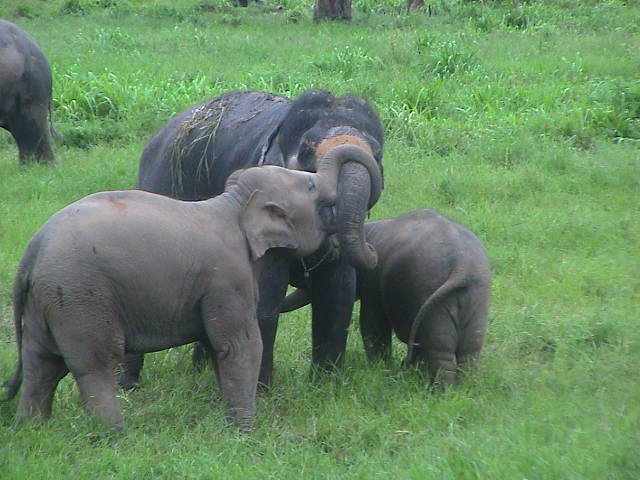
Elephants bonding using their trunks.
1. Altruism In Elephants That Care and Grieve
Elephants have the longest gestation time of any land fauna -22 months - significant that the bond between mother and baby is particularly strong. Experienced mothers in a herd ofttimes show care and concern for new mothers who need extra aid with their babies. The veterans will take turns looking subsequently the new baby, guiding it with their sensitive trunks, giving fourth dimension for the new mother to proceeds free energy and so she has enough quality milk for her offspring.
There are also documented examples of developed elephants helping to rescue a baby elephant when information technology became stuck in deep mud at a watering pigsty in Africa. I or two carefully scraped the mud away from effectually the baby whilst another nudged it slowly so that it was able to break free.
Behaviour similar this helps ensure the group survives and bonds the herd together.
Recent studies by Dr Joshua Plotnik at the University of Cambridge demonstrate beyond uncertainty that elephants practice have a high level of cooperative ability on a par with those of chimpanzees. You can check out his findings in the National University of Sciences Journal.
Every bit National Geographic correspondent Virgina Morell writes : 'Elephants help each other in distress, grieve for their expressionless, and experience the same emotions equally each other - but similar us.'
National Geographic 23.two.2014
Looking at the evidence it seems that elephants are to a degree altruistic when it comes to sharing and caring and looking later their ain.
Gyre to Continue
Read More From Owlcation
two. Orangutans Are The Most Caring of Parents - Natural Altruism
Orangutans are in danger of becoming extinct in the wild through the actions of humans but if those who go along to destroy the habitat of this remarkable ape would just stop to accept note of the care orangutan mothers prove their babies perhaps they would cease their destructive means.
This remarkable ape whose name means 'old man (or person) of the woods' is ane of the near expressive of mammals.
Youngsters are with the mother for an incredible v years, on average, during which fourth dimension they learn all the skills necessary for adult life in the jungle forests. Mothers are extremely attentive to their babies' needs, risking their lives to protect them from predators and guarding precious infinite when others threaten.
It'south this level of selfless care and condone for self that suggests the orangutan is capable of donating behaviour when the demand arises.
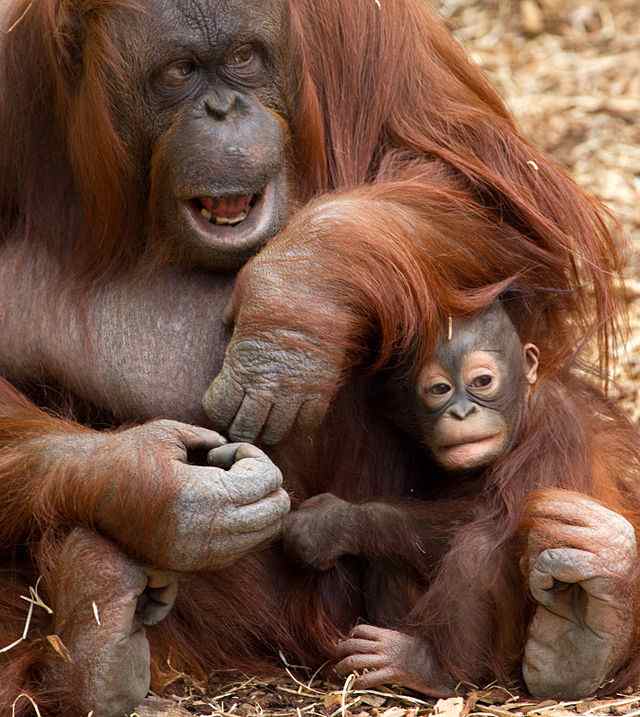
Orangutan mother and baby
Bats are ofttimes held in depression repute by humans because they are night creatures who wing in the dark, have a mistaken reputation for sucking human blood and live in smelly caves waiting to transform into evil vampires!
How wrong tin can we be. Bats are highly skilled fliers who use a sophisticated sonar mechanism for navigation. They feed on the fly, catching moths and other insects, and have organised social lives in communities. Some raise their young in special nurseries.
But one kind of bat, the mutual vampire bat (Desmodus rotundus) shows incredible caring for others within its family group - and not family unit groups - past regurgitating blood meals and offer information technology to swain bats who for one reason or another, haven't eaten that day.
This ensures that the colony survives and maintains strength, important factors in the life of a bat. How practise we know that the vampire bat does this? Well, apart from observations in the field at roost - by zoologists - scientific evidence exists that supports the thought of reciprocal altruism in this particular bat.
Truly wondrous. At the Academy of Maryland biologists carried out experiments which involved the report of vampire bats at roost. Some were given food, others not. Those who hadn't eaten were given regurgitated food past other bats and closer study showed that the hungry bats were in no way demanding food from their peers, they were given it.
Proof that the mutual vampire bat, far from being a mini-monster, shows care and perhaps concern for fellow bats who are going hungry.
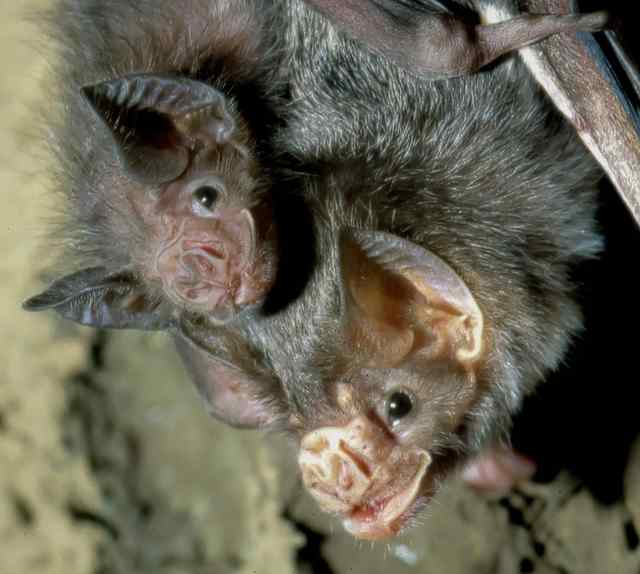
Vampire bats
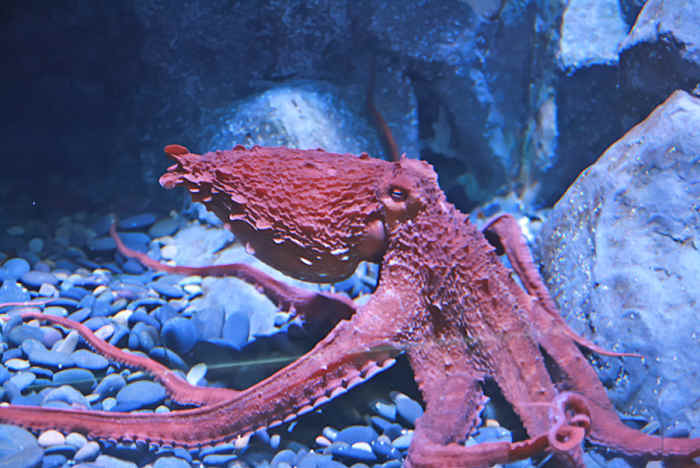
Carmine Octopus
4. Dedication of The Deep Sea Octopus
The deep sea octopus (Graneledone boreopacifica) has been filmed at a depth of 4,583 anxiety off the declension of central California. Here a mother was discovered with a brood of recently laid eggs, around 165 of them fastened to the side of a rocky ridge.
Incredibly, the movie coiffure unit from Monterey visited the octopus xviii times over the next 53 months and at each visit the mother was notwithstanding there in the same position, roofing her precious brood. On the 18th visit the mother had gone but the hatchlings were out, 155 of them.
No other fauna on the planet shows this kind of devotion to their eggs. As time progressed the divers in their submarine noticed the colour of the female parent changing, from red imperial to a ghostly grey. It seems the female parent octopus weakens and never feeds.
Scientists believe the behaviour to be then farthermost due to the low number of eggs laid for such a creature, the depth and coldness of the h2o, and fright of predators eating the young.
The ordinary octopus is a very intelligent creature with an ability to limited great intendance for its young. The mother, laying betwixt 50,000 and 200,000 eggs, shows real dedication during the viii weeks of her life when she protects her potential babies.
Once the eggs have been laid in a safe identify she will button currents of h2o over the eggs and so they become enough oxygen, keeping them live. So busy is the female octopus her food intake lowers and frequently mothers just fade away to null in an effort to keep the babies live. Once they have hatched out she will dice. Non many animals show such dedication.
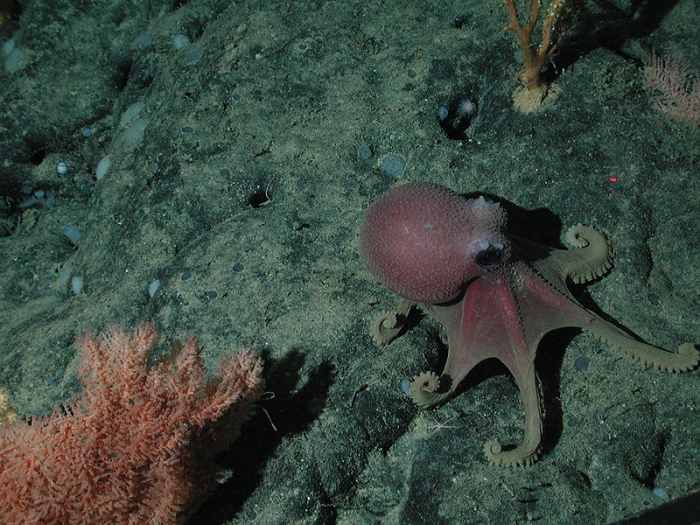
Deep Sea Octopus (Graneledone boreopacifica
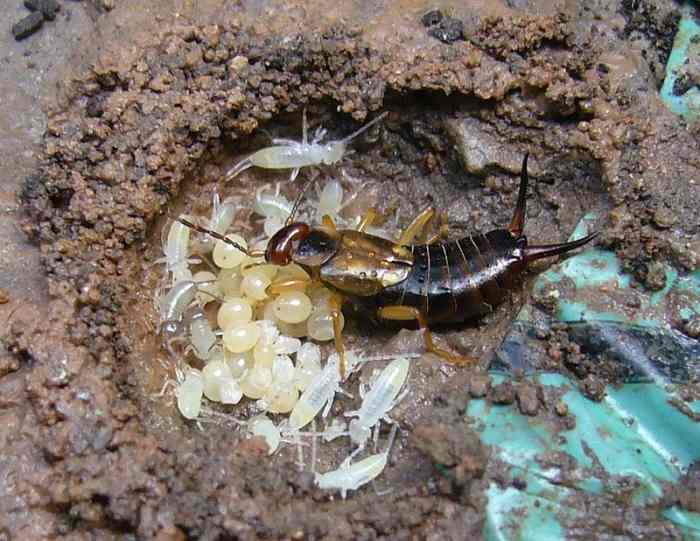
Mother earwig with eggs and young
five. Earwig
The earwig is a clever and caring parent insect who, in one case the eggs are set up to burst, will assist her babies break through the egg skin. In add-on she and so provides warmth with her body and cleans the babies to assist prevent mucus and other bacteria from building upwardly. Her regurgitated nutrient enables the offspring to become much needed free energy to acquit them through their initial growth stages.
The earwig female parent is an uncommonly intelligent insect, creating a nest especially for her young. And then not actually a creepy crawly at all!
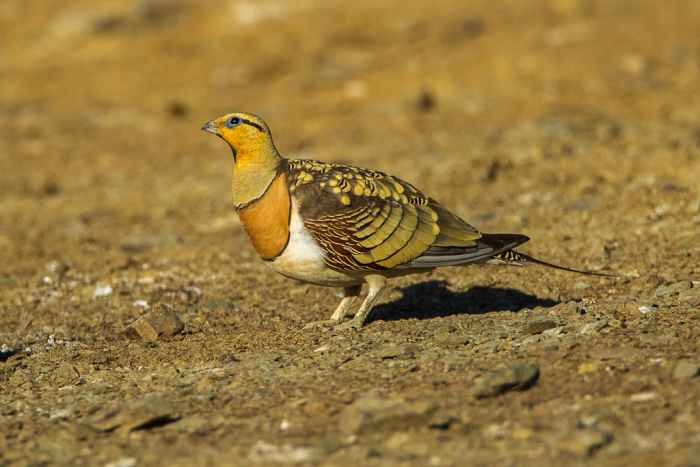
Sand bickering
6. Sand Bickering
The sand grouse of southern Africa displays amazingly caring behaviour by travelling long distances to fetch much needed water for its immature. The male often flies miles to a fresh water lake where it volition wade in and immerse itself in the life saving waters. Special feathers with extra barbules on aid keep the water close to the bird's breast as it flies back to the nest.
When the young have had their fill, snuggling up close, the developed bird and then dries off once more before starting another h2o journey.
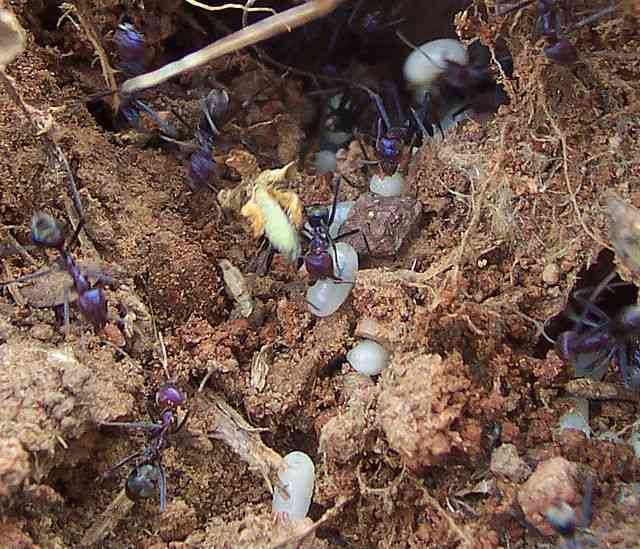
Ants caring for their eggs
7. Selfless Acts of the Ants
Ants are not anybody's thought of a caring kind of creature but studies have shown that some ants have unbelievable habits and behaviours that could be construed as altruistic.
Worker ants for example care for their eggs by licking them and if needs exist moving them to new cleaner safer chambers. They volition often comport food and water in a split stomach and share this with others who may not take enough.
Ants too carry the dead and diseased out of their nest thus helping keep the colony healthy and free of affliction.
We know how well organised ant colonies are and how each ant has a specific part to play in keeping the community good for you. At that place is a danger of projecting human emotions and feelings onto the ant but how else can we explain these acts of selfless devotion except through our linguistic communication?
Such acts cannot exist measured or gauged, they can only exist observed and described. An ant may exist low down on the evolutionary calibration but that doesn't exclude information technology from the donating scale.
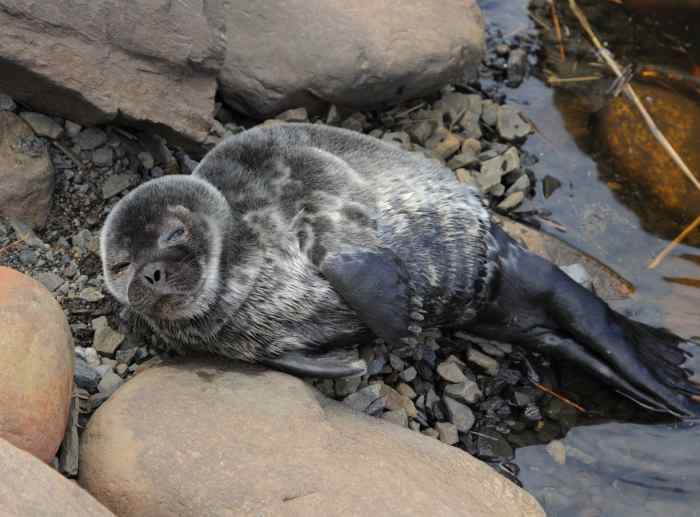
Young Ringed Seal (Pusa hispida botnica)
viii. Ringed Seal
Out in the freezing snow and ice of the Arctic the ringed seal has many enemies who would easily make a meal of the young. Polar bears and orca whales are among them. To help keep her pups safety the mother builds a not bad snow cave or lair above the water ice where her babies, subconscious from view, can keep safe.
Inside she tin can feed and care for her offspring and help them grow into healthy young adults.
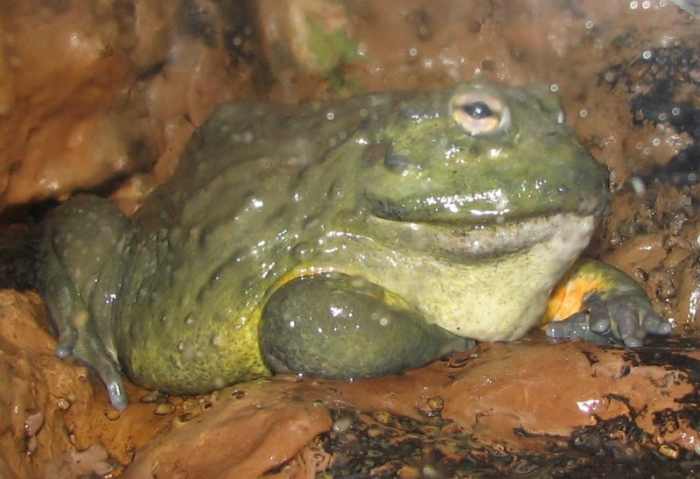
South African Bullfrog (Pyxicephalus adspersas)
9. South African Bullfrog
Living upwardly to xl years and growing upwardly to 8 inches in diameter this bullfrog eats lots of different creatures, from minor mammals to other frogs. A truthful giant in the frog world.
What separates them from other bullfrogs is their exceptional intendance and bravery when looking after their eggs, which they guard against predators. They dig special trenches which assist keep the hatched tadpoles free from danger, the adults standing up to snakes and other creatures looking for an easy meal. Simply the tadpoles also face up danger. The male volition sometimes consume the weaker ones!
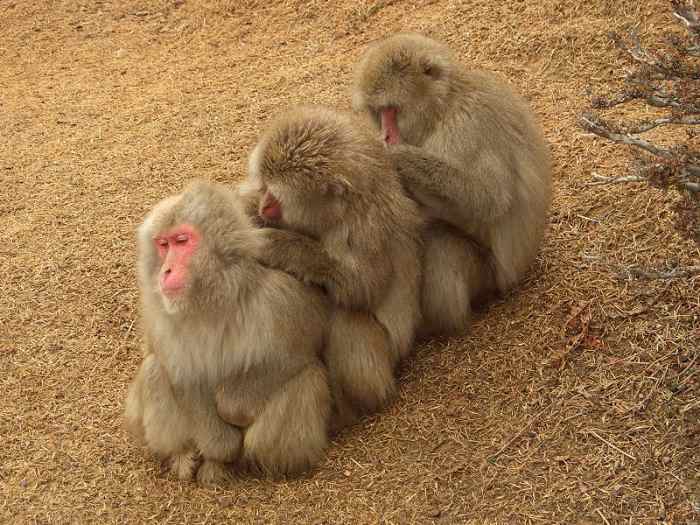
Monkeys grooming (Mucaca fuscata)
10. Primates - Monkeys
The term 'If you scratch my back I'll scratch yours' could certainly be practical to the primates as they are well known for their grooming habits, where one monkey picks parasites from some other's body. Not only is this a quick way to get a snack information technology helps bond individuals and eventually whole communities.
But is information technology donating behaviour? In a sense yes it is, because one monkey risks being attacked by a predator whilst de-bugging another. In some other it'due south but a style of getting on in primate life, of doing a job for someone and hoping that they in turn will reciprocate.
Inquiry past evolutionary biologists Filippo Aureli and Gabriele Schino at Liverpool John Moores University in the UK seems to evidence across reasonable doubt that primates do groom each other in an altruistic fashion. Their studies showed that grooming takes place more oft between unrelated monkeys more than those who were directly family unit.
Picking off those irritating parasites is pretty serious monkey business, as it leads to all round greater fitness for the social group.
Can We Show Altruism Exists in Wildlife?
Pure altruism should be all virtually self cede in the here and now, helping others for no credible future reward or reciprocal act. Simply does this ideal sort of altruism be within the human race let alone amid the so called lower animals?
Perhaps not? Perhaps aye? It'south a difficult one to phone call. Information technology's tempting to view the actions of animals through the rose tinted lens of man emotion - nosotros see 1 animal helping another for no reason other than empathy and caring and are then apt to call all animals altruistic to some caste.
I think there are genuine acts of altruism inside some animal species. Scientific research has shown again and again that there is something at work amongst certain species, that animals are sensitive to the welfare of others. This is something which cannot be measured but does deserve to have appropriate language applied to information technology.
- Whether an act of care or altruism is purely a genetic urge is notwithstanding to be proved or disproved. Perhaps there is no definitive answer and never will be.
What seems to exist true is that individual animals who show care, who aid family unit and others, strengthen the bonds between members of the group. Evolution at its very all-time?
© 2015 Andrew Spacey
Andrew Spacey (writer) from Sheffield, U.k. on July xv, 2015:
Thank you for the supportive visit Svetlana. Yep, most of the current research I looked at definitely points up empathy and reciprocal altruism and there is also evidence of kin altruism - these are what y'all might call scientifically verified. Random acts of pure altruism are the difficult ones to endeavor and ascertain - is the creature behaving this fashion because it is compassionate or because survival instincts of the group are the priority? Fascinating to think that the thin line is sometimes blurred.
Lana Adler from California on July fourteen, 2015:
Interesting! This is the subject that I'grand very curious virtually, personally. I think nearly of the examples of creature altruism can be said to be kin altruism (and reciprocal altruism sometimes, then either manner non "pure" altruism). Only I always wondered why do dolphins assistance humans? There are so many documented cases of this miracle. Do they consider us their "kin"? Voted up!
Andrew Spacey (author) from Sheffield, UK on July 01, 2015:
Thanks for the visit and comment, much appreciated.
JR Krishna from India on July 01, 2015:
Very well written hub with beautiful pictures and video.
Voted up and shared
Andrew Spacey (author) from Sheffield, Great britain on June 25, 2015:
Many thanks for the visit Chitrangada. The creatures out there continue to surprise, puzzle and make us wonder.
Chitrangada Sharan from New Delhi, India on June 25, 2015:
This is such a wonderful hub with incredible pictures and video!
Your article beautifully confirms the Altruistic beliefs of some of these wild fauna.
I am very addicted of watching the Discovery channels well-nigh wildlife and your hub seems like an extension of the animal life shown in that location. Most of the animals practice non harm Humans unless attacked. There are many things we tin learn from them, especially caring for their fellow species and their altruistic behavior.
Thanks for sharing and voted up!
Andrew Spacey (author) from Sheffield, United kingdom of great britain and northern ireland on June 16, 2015:
Thanks Ann, capeesh your visit. It is truly moving to picket some animals take time out to help others.
Ann Carr from SW England on June 16, 2015:
This is a bully list of animals who care. I knew near the elephants and the octopus but not most of the rest. I saw a nigh touching television set documentary about elephants returning to the site of a dead relative, to grieve together.
Fascinating, with expert arguments on both sides for each instance.
Ann
Andrew Spacey (author) from Sheffield, Britain on June 15, 2015:
Thank you for the visit Buildreps, appreciated. Yes in that location is overwhelming evidence to show that certain animals treat others with selfless acts of pity and welfare.
Buildreps from Europe on June 15, 2015:
Beautiful very well crafted Hub, Andrew. Yous showed obvious in this Hub that compassion or empathy is not exclusively reserved for Homo Sapiens.
Andrew Spacey (writer) from Sheffield, UK on June xi, 2015:
Thanks for the visit, capeesh information technology. Yes, the octopus is altogether an incredible creature, with intelligent tentacles and a super brain.
corking from Home Sweetness Home on June 11, 2015:
Wow the octopus shows groovy sacrifice that could cost its life. If humans could so that, wouldn't information technology be cracking
Andrew Spacey (writer) from Sheffield, UK on June 08, 2015:
Thank you for the visit Katiadejuan, capeesh it very much. Interesting scenario you outline. The more than I wait into this subject the more I'm convinced that in some species altruistic behaviour isn't an exception it's the norm.
Katia De Juan from Inverness, UK on June 08, 2015:
Loved this hub, Andrew.
It reminds me of a documentary that I saw (I don't call back the championship) in which appeared a group of primates where some of them were using rocks to crack open some nuts. Each monkey had his/her rock, except one, that didn't had any, so he was trying to open it slamming information technology into the ground, but he wasn't able to open up it, so after a while he stopped and stood there with a sad face. So suddenly, one of the others, who had been watching him during all the procedure, approached him and lent him the one he was using.
Well, to me that'south a clear testify of altruism, because in order for that to happen, firstly the monkey had to make utilise of his empathy to understand what was happening, and so show altruism by renouncing his possibility to go along eating more than nuts, to help the other.
Kristen Howe from Northeast Ohio on June 07, 2015:
Andrew, I loved this hub with the altruism descriptions and the lovely photos to lucifer it. Very beautiful through and through. Voted up!
Source: https://owlcation.com/stem/Altruism-10-Examples-of-Wild-Animals-Caring-For-Their-Own
0 Response to "What Animals Seem Invincible Agains Each Other"
Post a Comment